

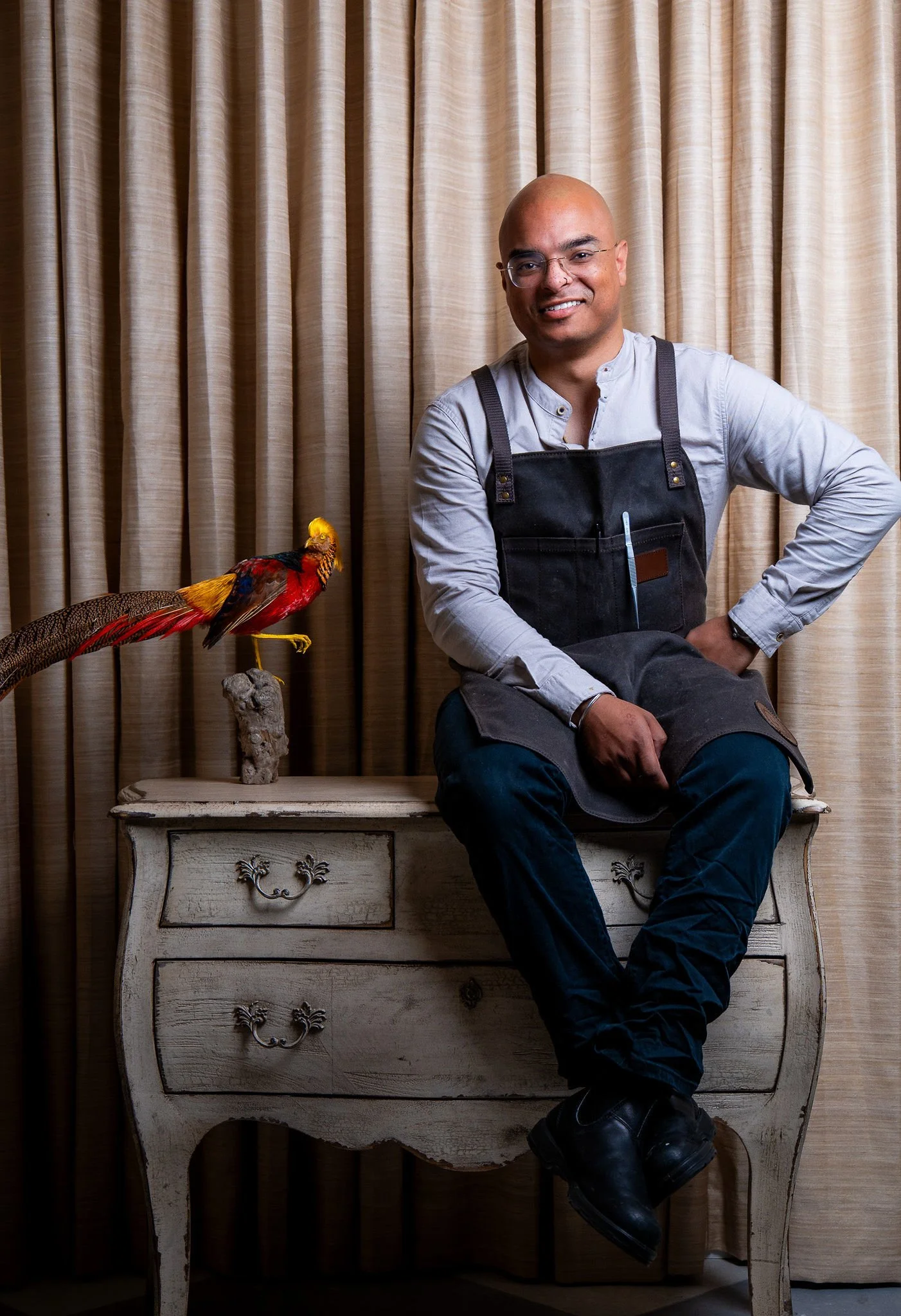
Chef Julian was raised on the Lower East Side of New York City. At fourteen years old, he began pursuing a culinary career by knocking on local restaurants’ doors and asking to work in their kitchens. One restaurant agreed, and he spent a year washing dishes while observing and absorbing as much of kitchen life as he could.
His formal culinary training began at Malt & Mash, where he worked as a commis and met Chef Nahid Ahmed, who would become his primary mentor. At Malt & Mash, Julian experienced a fine dining kitchen for the first time and began to understand the structure, precision, and technical standards required at that level.
He later joined Alder under Chef Wylie Dufresne, where he was first given a knife and a paycheck. At Alder, Julian began learning recipe development under Chef Jon Bignelli. When Chef Bignelli moved on to Sons & Daughters, Grand Army, and later Out East, Julian followed, progressing through the brigade system and ultimately earning the title of Sous Chef. During this period, his work focused heavily on modernist technique and molecular gastronomy, with an emphasis on precision, texture manipulation, and technical control.
In parallel to his full-time roles, Julian collaborated with Chef Nahid Ahmed on pop-ups for over eight years. This sustained mentorship was foundational to his development. Under Chef Ahmed’s guidance, Julian refined his understanding of classical sauce work, layering of flavor, and disciplined palate development; principles that continue to define his cooking style today. In 2019, Chef Ahmed opened Luthun in New York City, where Julian served as Sous Chef until the restaurant’s closure during the COVID-19 pandemic.
Following his time in New York, Julian relocated to Florida and joined Knife & Spoon as Sous Chef. During his tenure, the restaurant was awarded a Michelin star. At Knife & Spoon, his culinary perspective evolved significantly. Working in a region with year-round growing seasons and direct access to diverse seafood, he shifted his focus toward fermentation, hyper-local sourcing, and waste minimization. He developed what the team referred to as a “green menu,” an internal system designed to reduce waste and maximize ingredient utilization. Excess vegetables were juiced and transformed into vinegars; trim and secondary cuts were inoculated and developed into garums, fermented condiments, and eventually demis and sauces. This approach deepened his understanding of preservation, fermentation, and sustainable sourcing, and remains integral to his culinary philosophy.
Julian later relocated to Northern California, where he currently serves as Executive Chef of Tasting House in Los Gatos and Executive Chef of VICINITY, a tasting-menu-only restaurant he recently opened.
In California, his work centers on capturing a distinct sense of time and place through ingredient-driven cooking. He collaborates with approximately thirty-five local farms, including several focused on native Californian species and regenerative agriculture. His sourcing model emphasizes proximity, seasonality, and environmental stewardship.
Julian’s cooking reflects the technical rigor of his New York training, the mentorship lineage of Chefs Nahid Ahmed, Wylie Dufresne, and Jon Bignelli, and the sustainability-driven evolution shaped during his time in Florida. At VICINITY, he applies these combined influences to create tasting menus rooted in Northern California’s landscape, while maintaining the precision and discipline developed in fine dining kitchens throughout his career.